Detailed Component Locations - Electronic Control Unit:
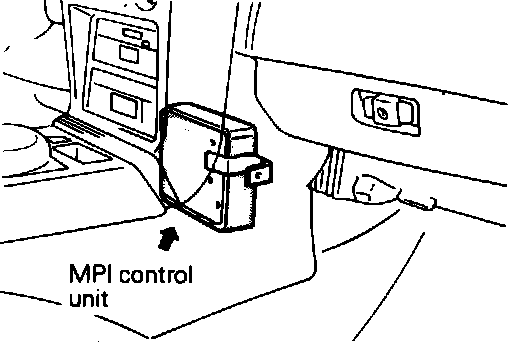
Basic operation
The Electronic Control Unit (ECU) controls the fuel injection system, ignition timing, and the idle speed control system. The ECU also interrupts the operation of the air conditioning and EGR systems, and controls power to the fuel pump (through the control relay). The ECU consists of an 8-bit microprocessor, random access memory (RAM), read only memory (ROM), and an input/output interface.
Based on information from the input sensors (engine coolant temperature, barometric pressure, air flow, etc.), the ECU determines optimum settings for the output actuators (injection, idle speed, ignition timing, etc.).
Location
Located in front of the center console.
Self-Diagnosis
The electronic control unit constantly monitors input and output signals for correct operating range. If an irregularity occurs, the ECU stores a trouble code which can be accessed via the self-diagnosis output terminal. Diagnostic results can be read with a voltmeter or multi-use tester.
ECU trouble code memory is maintained by direct battery voltage so diagnostic results are held in memory even if the ignition key is turned off (except for the oxygen sensor code). However, trouble codes will be erased if the battery terminal or the engine control unit connector is disconnected.